Vol. 26 No. 1 (2026): Volume 26, Number 1

LUKANKA
Leslie Korn, PhD, MPH Editor-in Chief
In this June 2026 issue of the Fourth World Journal, we proudly showcase scholars dedicated to advancing women’s traditional medicine. For this second special series issue, we received an abundance of submissions, necessitating a longer-than-usual issue and underscoring the field’s dynamic growth.
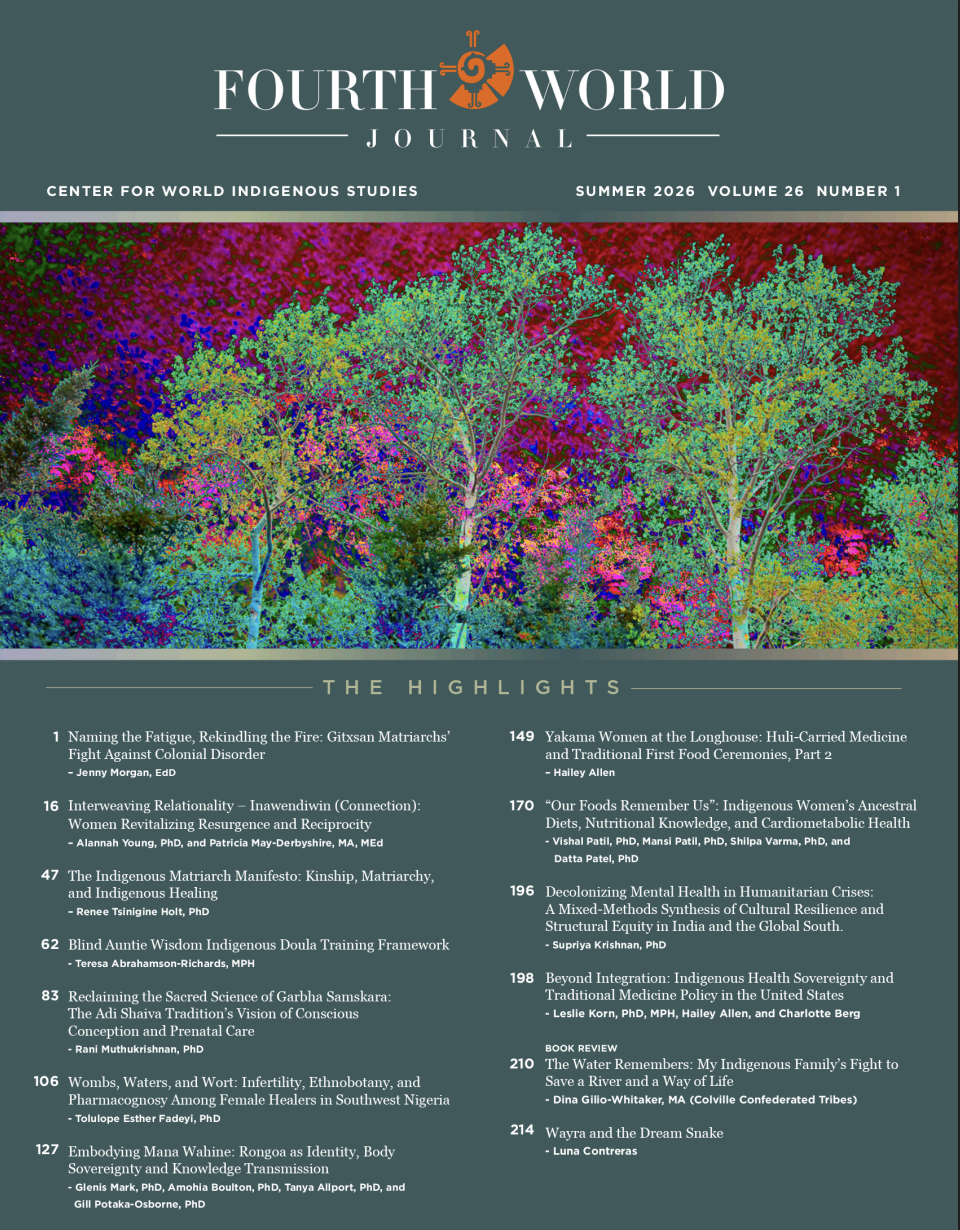
The vibrant cover art, entitled Night Trees, generously contributed by distinguished feminist sociologist and activist Estelle Disch, PhD, epitomizes the remarkable diversity of branches and scope we see emerging in the scholarship on women’s traditional medicine across the globe. The adage “The personal is political” resonates here, as many authors integrate self-reflection and personal process into their scholarship. Women scholars continue to promote the understanding that knowledge emerges from lived action and leads to restoration, justice, and collective wellbeing.
Jenny Morgan’s article grounds the issue in Indigenous feminist scholarship from Gitxsan territories in Canada. She introduces Post-Settler Disorder and Colonial Contact Fatigue, critiquing settler colonial structures and highlighting matrilineal knowledge, humor, and women’s leadership as pathways to healing and renewal. The legacy and ongoing sequelae of colonization, and their effects on traditional medicine worldwide, are themes that reverberate throughout many articles in this issue.
Building on Morgan’s discussion, Alannah Young and Patricia May-Derbyshire draw on North American Indigenous traditions to explore how women support cultural resurgence through kinship and joint responsibility. Their work emphasizes relationality as fundamental to Indigenous healing systems and community continuity.
Continuing the focus on kinship and relational accountability, the next contribution centers on matriarchy as a healing structure. Renee Tsinigine Holt’s “The Indigenous Matriarch Manifesto” examines matriarchy as a framework for healing intergenerational trauma using Diné and Nimiipuu perspectives. Through ceremony, foodways, and kinship accountability, Holt shows that Indigenous healing is collective and relational.
Expanding from matriarchy and kinship, the restoration of women’s healing authority is next studied through the domain of birth and reproductive care. In Reclaiming Auntie Wisdom: Cultivating Indigenous Doula Pathways for Birth Justice and Community Healing, the authors highlight North American Indigenous birth justice work through the Indigenous Birth Justice Network. Indigenous doulas are knowledge keepers and healthcare advocates, advancing a framework for reproductive care that supports cultural sustainability, maternal wellbeing, and Indigenous sovereignty.
Continuing the theme of reproductive knowledge and maternal wisdom, this issue extends to ancient South Asian prenatal sciences, as Rani Muthukrishnan examines prenatal traditions in India’s Adi Shaiva tradition, drawing on Sanskrit texts, rituals, and modern applications. The paper calls for recognition of Garbha Samskara as a sophisticated Indigenous science and critiques the erasure of embodied feminine knowledge under colonial and modern paradigms.
Drawing on previous discussions about fertility and women’s healing knowledge, the next article discusses West African traditional medicine. Tolulope Esther Fadeyi analyzes Yorùbá communities in Southwest Nigeria, where fertility and reproductive care are closely linked to Indigenous cosmologies and women’s healing practices. Examining ethnobotany and female healers, it highlights Yorùbá medicine’s relevance in reproductive health.
The issue next shifts to consider Indigenous healing practices as expressions of bodily sovereignty and cultural reclamation. Glenis Mark, Amohia Boulton, Tanya Allport, and Gill Potaka-Osborne center Māori healing traditions in New Zealand. Using Kaupapa Māori methodologies, they show rongoā Māori functions as a healing practice and as a means of reclaiming bodily sovereignty and intergenerational knowledge for Māori women.
Moving from Māori healing traditions, the focus shifts to Yakama women’s ceremonial foodways. Hailey Allen examines Yakama ecological and ceremonial knowledge in the Pacific Northwest United States. Through elder interviews and her insider position as a participant in Longhouse and First Foods practices, she shares how women sustain reciprocal relationships with land, foodways, and spiritual traditions amid colonial pressures.
Building upon the discussion of ancestral foods and women’s knowledge, the next contribution deepens the connection with collective wellbeing. “Our Foods Remember Us” explores the link between ancestral diets, women’s nutritional knowledge, and health outcomes, directly connecting Indigenous food sovereignty to cardiometabolic health and cultural resilience, as discussed in prior articles.
Shifting the focus from nourishment and food sovereignty, the scope of the issue broadens to explore the psychological and communal dimensions of healing during crisis. In this context, Supriya Krishnan critiques colonial mental health frameworks in humanitarian crises across India and the Global South. Through mixed-methods and participatory research, she proposes community-led, culturally rooted models of psychosocial support that prioritize epistemic justice and resilience.
Building upon community-led psychosocial models, we now engage with broader policy concerns that shape access and engagement with Indigenous healing systems. The forthcoming policy commentary by Leslie Korn, Hailey Allen, and Charlotte Bryn Berg connects these models to challenges in traditional medicine policy, explores the effects of US federal health policies on Indigenous communities in the United States, and examines how global frameworks, including the strategic plans by WHO, both foster and imperil traditional medicine. The full commentary will be available online soon.
Dina Gilio Whitaker reviews Amy Bowers Cordalis’s book, The Water Remembers, showing how the restoration of the Klamath River and Yurok lifeways reflects the central theme of healing through Indigenous medicine and cultural renewal found throughout the issue.
As in our previous issue, we welcomed narratives that shared diverse ways of knowing, and the issue culminates with Wayra and the Dream Snake, a transformative dream story that affirms the enduring significance of visionary experience in women’s traditional medicine across cultures.